Oxyile Editorial
Peer-to-Peer Lending UK: How It Works & Why Brits Are Trying It
17 Sept 2026
What Is Peer-to-Peer Lending And Why Are So Many Brits Trying It?
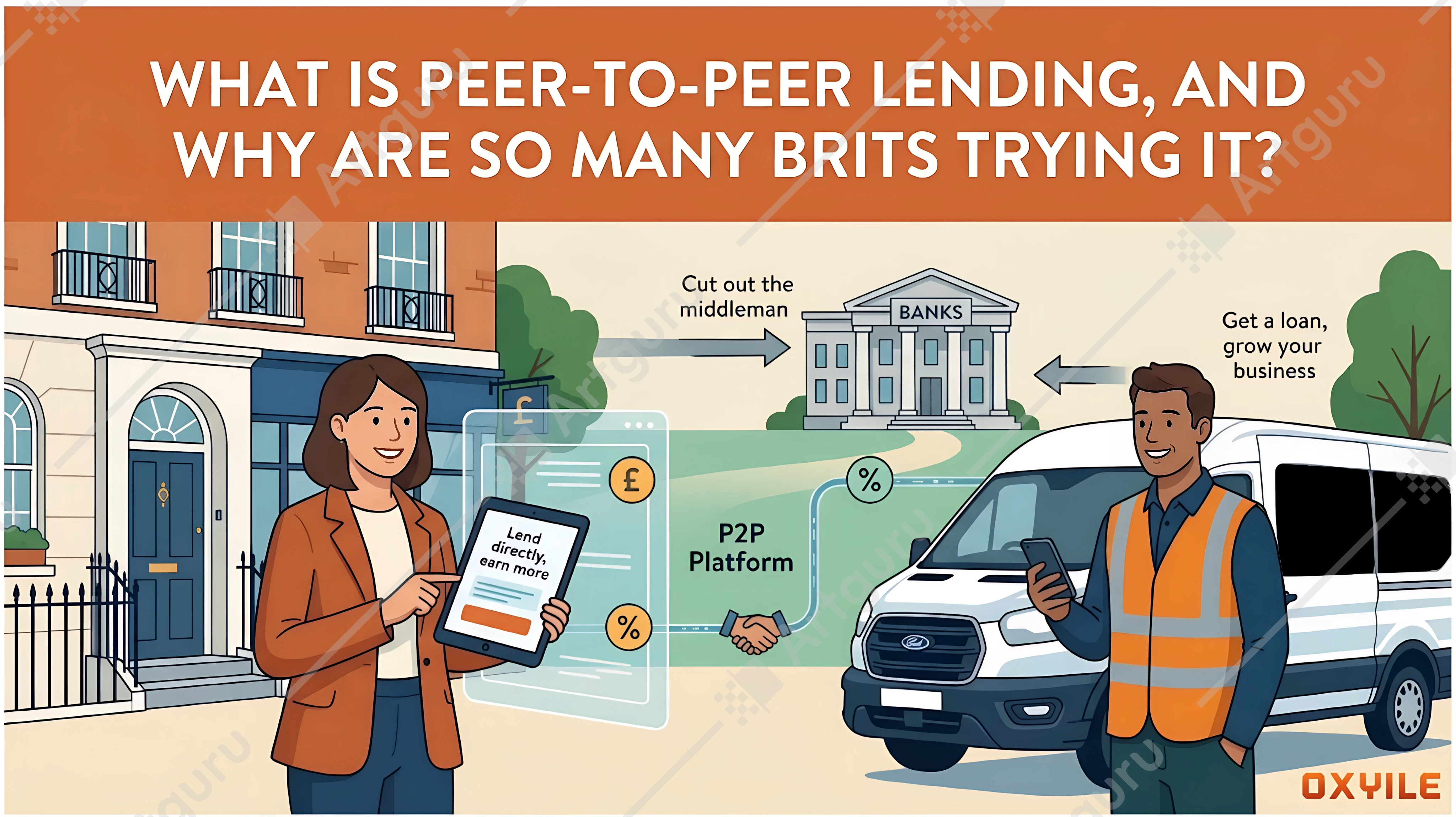
Picture two things happening on the same street. One neighbour has £5,000 sitting in a savings account, earning barely enough interest to notice. Another neighbour needs £5,000 for a van to grow their business, and is dreading the paperwork and the wait at the bank. Neither of them knows the other exists.
Peer-to-peer lending, P2P for short, is what happens when a platform introduces them.
The basic idea
Instead of depositing money with a bank, which then decides who to lend it to (and pays you a small fraction of what it earns doing so), P2P lending lets you lend directly to a real person or business, and agree the interest rate between you. Cut out enough of the middleman, and there's more room for both sides to come out ahead: the lender can often earn more than a typical savings rate, and the borrower can often get a fairer rate than an unsecured bank loan, because the platform's costs are lower than a branch network's.
It's not a new idea in principle. People have lent to each other for as long as money has existed. What's new is the platform: FCA-regulated technology that handles the matching, the paperwork, and the collection, so it doesn't rely on you personally knowing, or trusting, a stranger.
Here's roughly how it plays out in practice:
A borrower applies, sharing the financial information a lender would reasonably need to make a decision: how much, for how long, and why
A guarantor is arranged, so there's a second person standing behind the loan, and often collateral too
Investors browse live listings and decide, individually, who they're comfortable lending to, often spreading smaller amounts across several borrowers rather than backing one loan in full
Both sides agree the rate. Nobody's handed a take-it-or-leave-it number; it's a genuine negotiation, even if a brief one
The agreement is formalised, funds move electronically, and repayments follow an agreed schedule until the loan is closed
None of that requires the lender and borrower to have ever met, or even to know each other's names beyond what's needed to make an informed decision.
Bank loan vs P2P loan: what actually changes
With a traditional bank loan, the bank sets the rate, and it's largely non-negotiable. With a peer-to-peer loan, the rate is agreed between lender and borrower directly.
With a bank, it's the bank lending your money, using your deposit as raw material. With P2P, it's you, lending directly to a specific borrower.
With a bank, you don't see who your deposit ultimately funds. With P2P, you see real data on the borrower before you commit.
If something goes wrong with a bank deposit, it's FSCS-protected, but you earn very little in return. With P2P, there's no FSCS cover, but a guarantor and structured protections are built into the loan itself.
With a bank, the profit mostly goes to the bank's margin. With P2P, it's split between the two people actually taking the risk.
The part most platforms bury in the small print
Here's the honest bit, because a genuinely smart money platform should say this loudly rather than quietly: P2P lending is not a savings account, and it isn't covered by the Financial Services Compensation Scheme (FSCS) the way a bank deposit is. If you lend money and the borrower doesn't repay it, that's a real loss, not a technicality. Anyone telling you P2P is "just like a savings account, but better" isn't giving you the full picture.
What it is, instead, is a form of investing: you're taking on real credit risk in exchange for a return that reflects that risk. That's a completely legitimate thing to do with your money. It's just not the same thing as parking it in an ISA, and it shouldn't be sold as if it were.
Who P2P lending is actually for
This matters as much as the upside. P2P lending tends to suit people who:
Have money they can afford to have tied up for the length of the loan, without needing it back on short notice
Are looking to diversify rather than put a large share of their savings into any single loan or platform
Understand that returns aren't guaranteed, and are comfortable doing their own homework on who they're lending to
It's a poor fit for money you might need at a moment's notice, or as a substitute for an emergency fund that genuinely needs to stay liquid and protected.
Where Oxyile fits in
This is exactly why the details matter. On Oxyile, every loan is backed by a guarantor as well as the borrower, a second person legally on the hook if the first can't pay, and every agreement (we call it a handshake) is recorded in a way that can't be quietly altered after the fact by anyone, including us. Investors get to see real data about who they're lending to before they commit a penny, and borrowers get to agree the rate directly rather than accept whatever a bank's algorithm decides for them.
None of that removes the risk that's inherent to lending money. What it does is make sure that risk is the only thing you're taking on, not opacity, not surprises, not fine print you find out about after something's already gone wrong.
A few quick questions people usually have
Is P2P lending actually regulated?
Yes. Operating a P2P lending platform in the UK has required FCA authorisation since 2014, and platforms are held to specific rules on how they present risk, assess borrowers, and handle client money.
Can I lose money?
Yes, if a borrower doesn't repay and the guarantor and any collateral don't cover the shortfall. That risk is real and shouldn't be understated. It's the trade-off for the returns on offer.
Do I need to be an expert to get started?
No, but you should understand what you're agreeing to before you do it, which is exactly what the rest of this series is for.
Is this the same as investing in crypto?
No. Oxyile uses blockchain technology to make agreements verifiable (more on that next week), but lending on the platform means lending real pounds to real people, not buying or trading any kind of digital currency.
Where this series goes next
Over the coming weeks, we're going to open up exactly how each part of this works: how your agreement is actually recorded, what happens if a repayment is missed, how your money physically moves from one account to another, and what all of this looks like from the other side of the table, whether that's as a borrower or a guarantor.
If P2P has always sounded interesting but a bit opaque, that's exactly what the rest of this series is for.
Related tags
- peer-to-peer lending explained
- P2P lending UK is P2P lending safe
- FSCS peer to peer
- Oxyile guarantor lending
- Fintech
- Personal Finance
- Investing for Beginners
- Understanding Investment Risk